
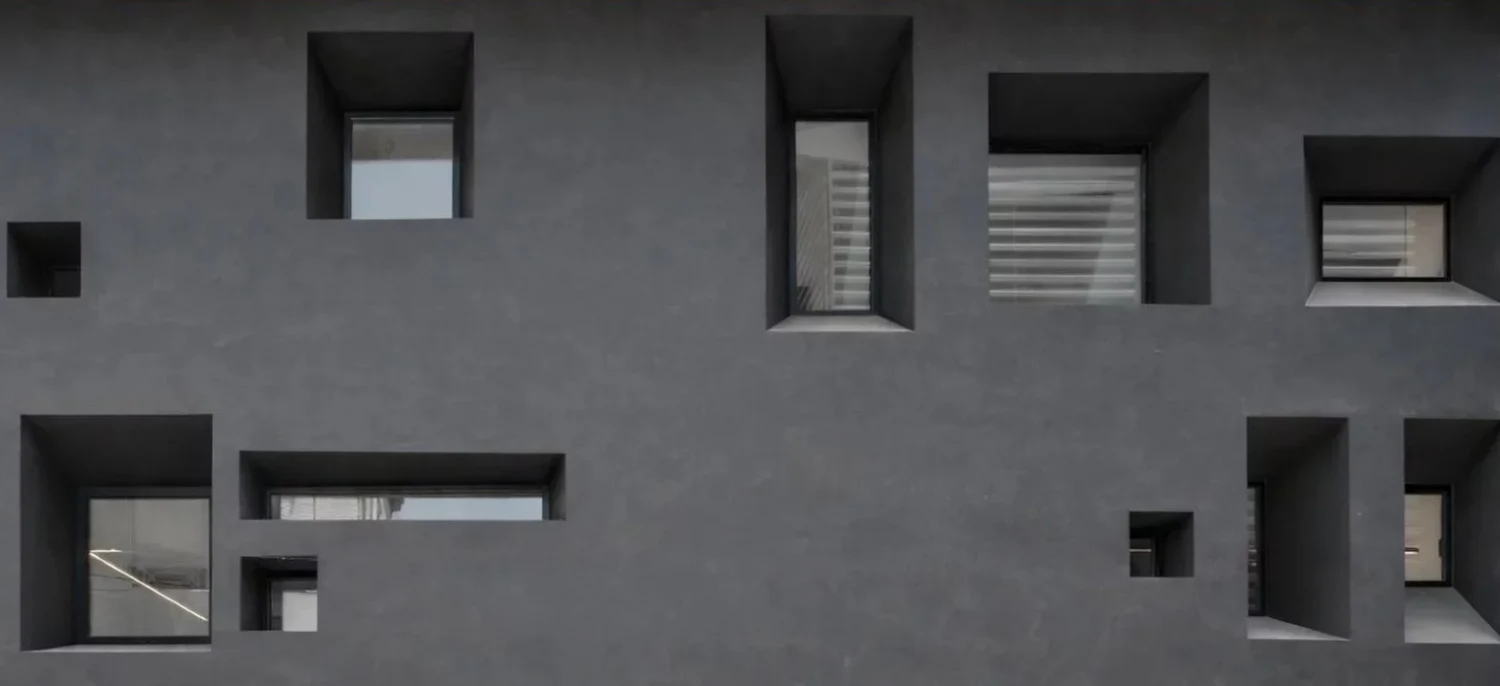
Exterior microcement colours: the 0-5-0 rule
Coloured exterior microcement lives in the sun, and the sun of the southern Mediterranean fades the colour of any building. This collection brings together photographs of real exterior projects in TECNOCEMENTO®, from whites to blacks, and the rule we use to look after them: 0-5-0.
Light tones, floors in the sun, dark façades and colour
Which colour to choose for an exterior, and what happens to it over the years. Each section has three photographs from real projects.
Already have a coloured exterior? Here is when and how to recoat it. And if you would rather browse, start with the light tones.
The TECNOCEMENTO® 0-5-0 rule
The TECNOCEMENTO® 0-5-0 rule: a coloured microcement in the southern Mediterranean sun is handed over in year 0, recoated in year 5 with a pigmented polyurethane topcoat, even if it still looks fine to the naked eye, because the first thing to age is the finish, and the microcement goes back to 0.
We use some of the most stable inorganic pigments there are and, even so, in the Levante sun, on Spain’s east coast, a black finish on a horizontal surface loses intensity within three years. On site we put it like this: the sun eats the colour. Maximum resistance does not mean forever.
Pigment is tested under a lamp; the finished work lives in the sun. No manufacturer publishes how much colour its microcement keeps outdoors. We tell you what we see.
Not even the best aliphatic polyurethane lasts forever in the sun: it yellows only a little, but it does yellow, and it loses its sheen. The first thing to age is the layer that protects the colour. That is why it is recoated.
Almost all the exterior work we do is in light tones, and that is no coincidence. The same loss of sheen that on a black finish reads as grey barely shows on a white finish: light tones stand up to the sun, or their ageing is less noticeable.
For terrace floors, patios and outdoor paving we recommend TECNOCEMENTO HIGH TRANSIT®, with a FORTE PLUS® finish. The shade is chosen afterwards, from the microcement colour chart.
Microcement floors in the sun: terraces, paths and pool decks
A floor gets sun all day, water and foot traffic: it is the surface that ages first, and the one to watch most closely until the year-5 recoat.
A pool deck falls under the rule; the submerged pool shell does not. We deal with it in microcement for swimming pools.
Black and dark grey microcement façades
On a vertical surface the sun is less punishing than on a floor, but on a dark colour any loss of sheen shows. Our own headquarters, in Elda, is black and faces west: it has gone three years without a recoat and still looks good. It will be due in year five.
For façades and vertical surfaces, TECNOCEMENTO PLUS®, with a FORTE PLUS® finish.
White microcement on the beachfront: the sun comes indoors too
In a beachfront apartment the sun does not stay on the terrace: it comes in through the glazing and crosses the living room from end to end. Here the floor is what gets the most sun, and that is why it is white.
The colour comes from the walls, in mauve, and the contrast from the wood of the island. Light and dark in the same space, as in the image that closes the series: an idea by tamatestudio generated with artificial intelligence, not a built project.
A vivid colour outdoors is chosen knowing that the sun works on it. Next to dry stone and greenery, pink and turquoise no longer look daring.
The stairs were done with TECNOCEMENTO HIGH TRANSIT® and a FORTE PLUS® finish; the metallic façade, with TECNOCEMENTO METALLIC®. All the shades are in the colour chart.
At TECNOCEMENTO® we sum up our approach to application like this: 40% load-bearing substrate, 40% applicator and 20% product.
Certified TECNOCEMENTO® applicators.
Before choosing the colour of an exterior, it is worth checking that the substrate is stable, whether there is any damp, and how the joints will be detailed.
How exterior microcement is recoated
The recoat does not fix a defect: it renews the layer that protects the colour before the sun wears it away completely.
- Year 0: handed over with the FORTE PLUS® finish.
- Year 5: recoat with a pigmented polyurethane topcoat, even if it still looks fine to the naked eye.
- Done well, the recoat penetrates the worn colour and, to the naked eye, restores the colour shown in the chart.
- Anything submerged, such as a pool shell, falls outside the rule. Indoors, without direct sun, the colour holds.
When is my project due for its recoat?
Tell us the year the work was completed, its orientation and the colour, and we will tell you when to check it.
Imagining colour in the open air
The idea comes before the finished work. These images were generated by tamatestudio with artificial intelligence: they are not built projects or photographs of microcement, they are ideas about colour and the continuous surface in the open air.
Can microcement be used outdoors?
Yes. For terrace floors and outdoor paving we recommend TECNOCEMENTO HIGH TRANSIT®; for façades and vertical surfaces, TECNOCEMENTO PLUS®. All our exterior systems are protected with the FORTE PLUS® finish. We explain it surface by surface in microcement outdoors.
Does exterior microcement fade in the sun?
Yes, to a greater or lesser extent. In the southern Mediterranean sun, a dark colour loses intensity even when inorganic pigments and an aliphatic polyurethane finish are used. The first thing to age is the finish: it loses sheen and yellows a little. Light tones hide it better. That is why we apply the 0-5-0 rule.
How often is exterior microcement recoated?
In the sun, in year 5, with a pigmented polyurethane topcoat, even if it still looks fine to the naked eye. Then the cycle starts again from 0.
Which microcement colours hold up best outdoors?
Light tones: whites, light greys and sand tones. The same loss of sheen that on a black finish reads as grey barely shows on a white finish. Dark colours can be used outside, but with their recoat planned from the design stage. Compare the shades in the microcement colour chart.
Does the recoat show?
Done well, the pigmented polyurethane penetrates the worn colour and, to the naked eye, restores the colour shown in the chart. Only a colorimeter can measure the difference.
Does the 0-5-0 rule apply to swimming pools?
For the pool deck and the edge, yes. The submerged pool shell is a different case: the water and its treatment change the conditions. We deal with it in microcement for swimming pools.
And indoors?
Indoors, without direct sun, the colour holds. The 0-5-0 rule is for exteriors in the sun.
Who can apply TECNOCEMENTO® outdoors?
Applicators and distributors trained by the brand in Spain and Europe. In the distributor directory you can find the nearest one; if you are an applicator, the brand runs applicator training courses.
Planning a coloured exterior in microcement?
Tell us which surfaces are involved, the approximate area in square metres, the orientation and the location of the project. Contact TECNOCEMENTO® so we can assess your project. TECNOCEMENTO® is a two-component microcement applied by professionals trained in the system.
Are you an applicator? Train with TECNOCEMENTO® and join the applicator network ↗
Another collection: microcement and wood ↗
← Back to Inspiration