
Microcement tilesA photo of microcement.
People ask me whether microcement tiles exist. Before I answer, let me tell you about the first time porcelain tiles beat me.
Years ago I designed a chain of Mediterranean-style restaurants, Tapelia. What tied all the venues together was the floor: a 5 cm concrete slab to which we added pigment and a latex resin, in a cold Mediterranean blue.
I didn’t saw-cut it. I thought the elasticity of the latex would be enough. I laid more than thirty of them all over Spain. I loved them. But they began to crack, as if they had all got angry with me at the same time. Even cracked, I was in love with them, but don’t talk about love to someone who has never known it. They were replaced with grey porcelain tiles, which added nothing to the Mediterranean story and had none of that tender look.
That was the first time porcelain tiles beat me.
Tomás Amat
Architect · TECNOCEMENTO
Seamless floorsBe water, my friend
Why a seamless floor?
A fluid that takes the shape of the space.
I have always loved seamless floors. The same floor running from the kitchen to the bathroom and on to the guest room, without changing, turns the house into a single space. The same goes for a studio or a restaurant. Bruce Lee put it better than anyone: “Be water, my friend”. A seamless floor is just that, a fluid that takes the shape of the space.
I built my first houses with concrete floors: cement, aggregate, water and protection. Never less than 8 cm, so it wouldn’t crack. It is poured at the start of the job, pumped from ready-mix trucks sent by the plant, and then it has to survive everything else: MDF boards on top, fierce supervision, wet curing in summer. I saw-cut it with joints of 2.5 mm or more, into bays of 25 m² at most, with no side longer than twice the other, around the columns and at the thresholds. With white cement, the second truckload almost always arrives a different colour. The same thing happens to me when I switch conversations with an artificial intelligence: however thorough the handover, the second truckload can arrive a different colour.
And even so, when the protection came off, one floor or another had cracked. It never bothered me: concrete is a living material and, as the Spanish fashion designer Adolfo Domínguez’s advertising proclaimed, wrinkles are beautiful. But some clients don’t want to move into their new home with a crack.
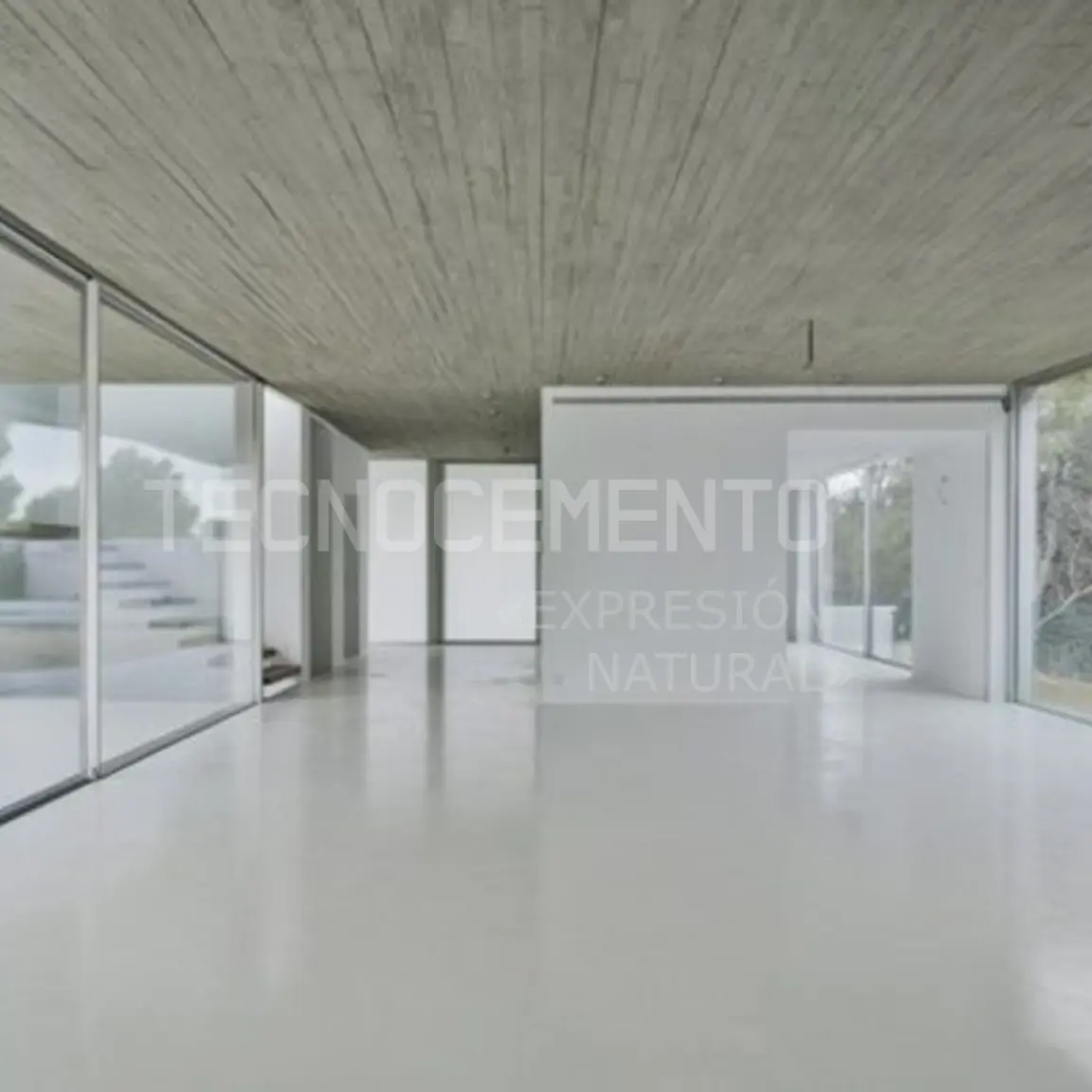
The origin of TECNOCEMENTOPolished concrete, power-floated concrete or microcement?
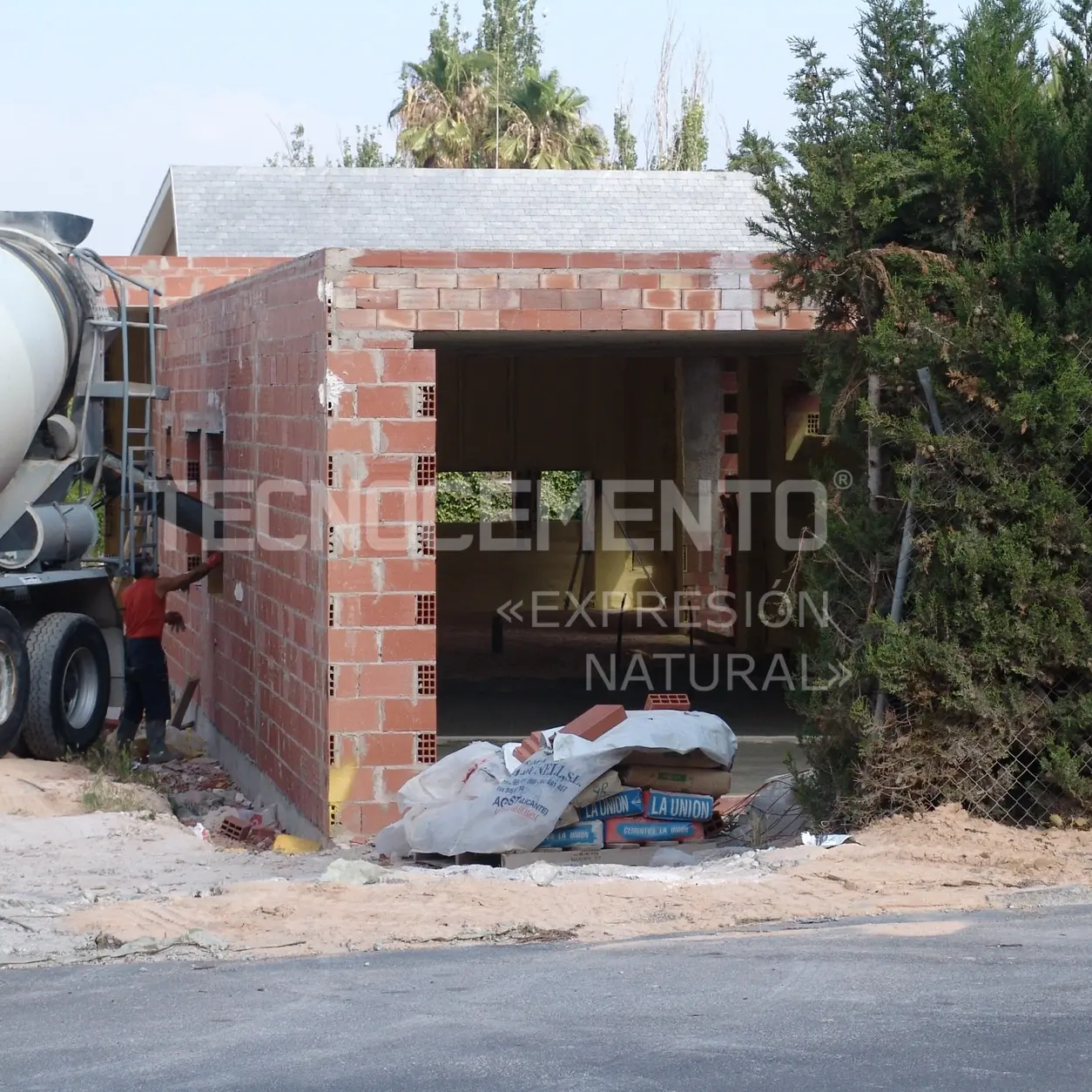
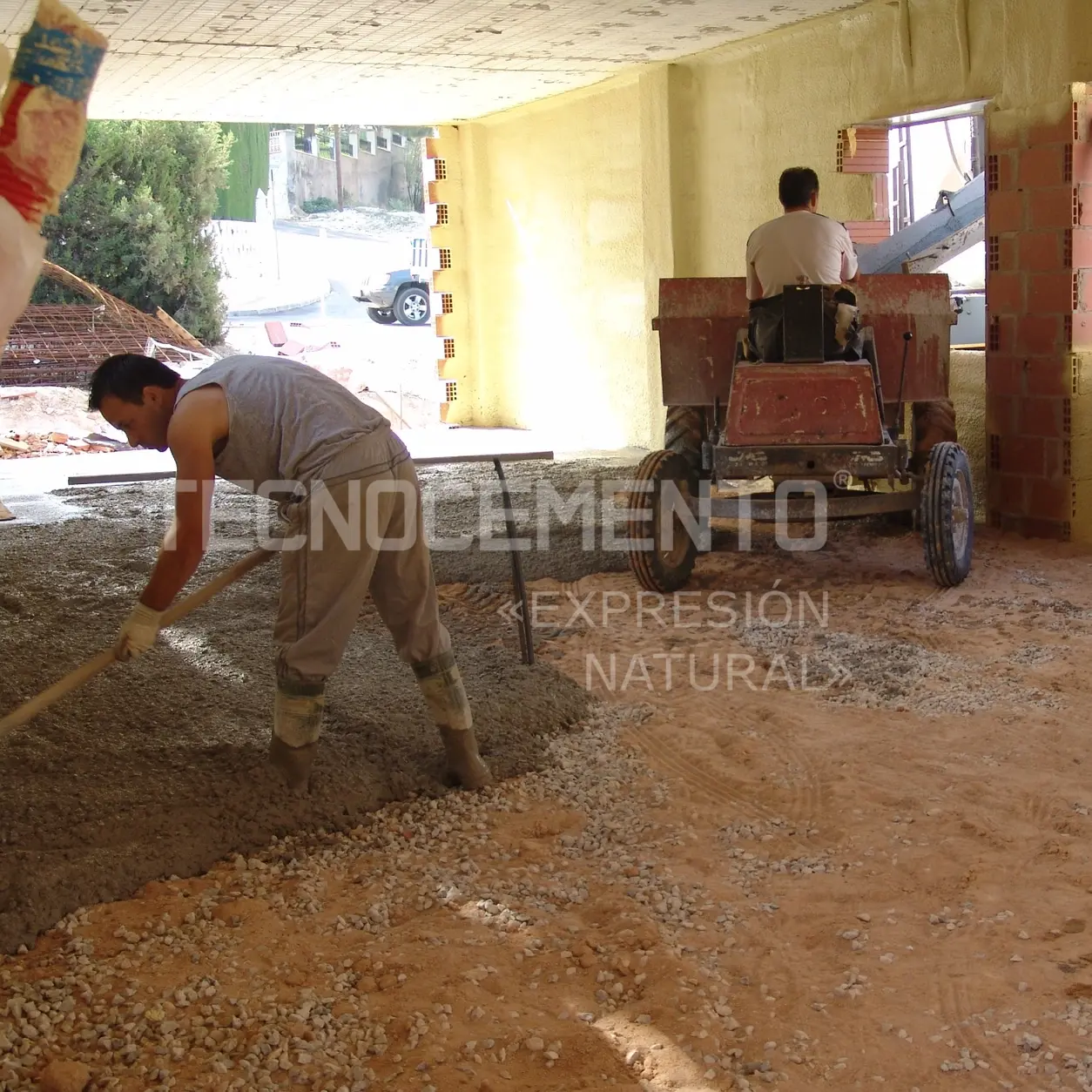
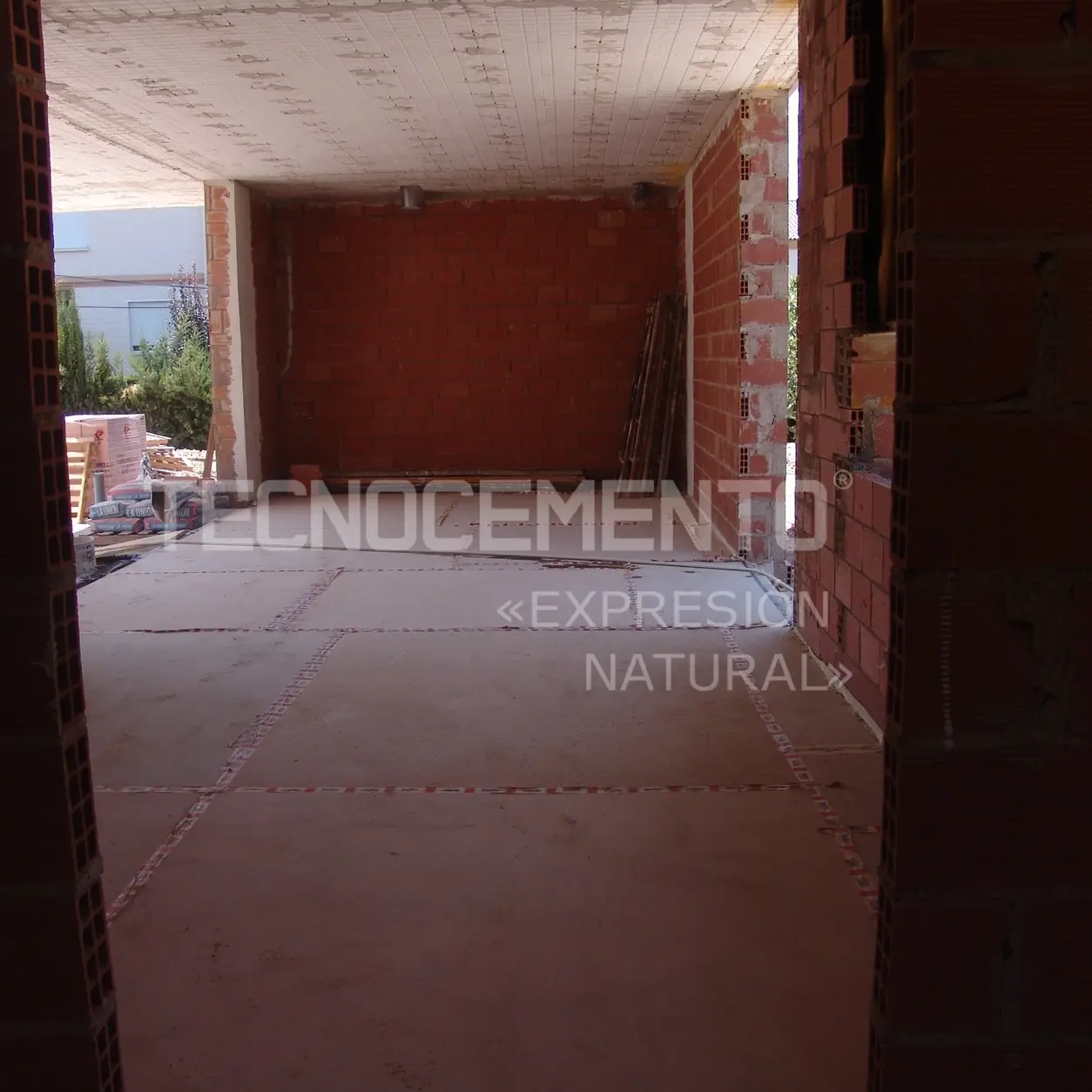
How was TECNOCEMENTO born?
The question that made me manufacture microcement.
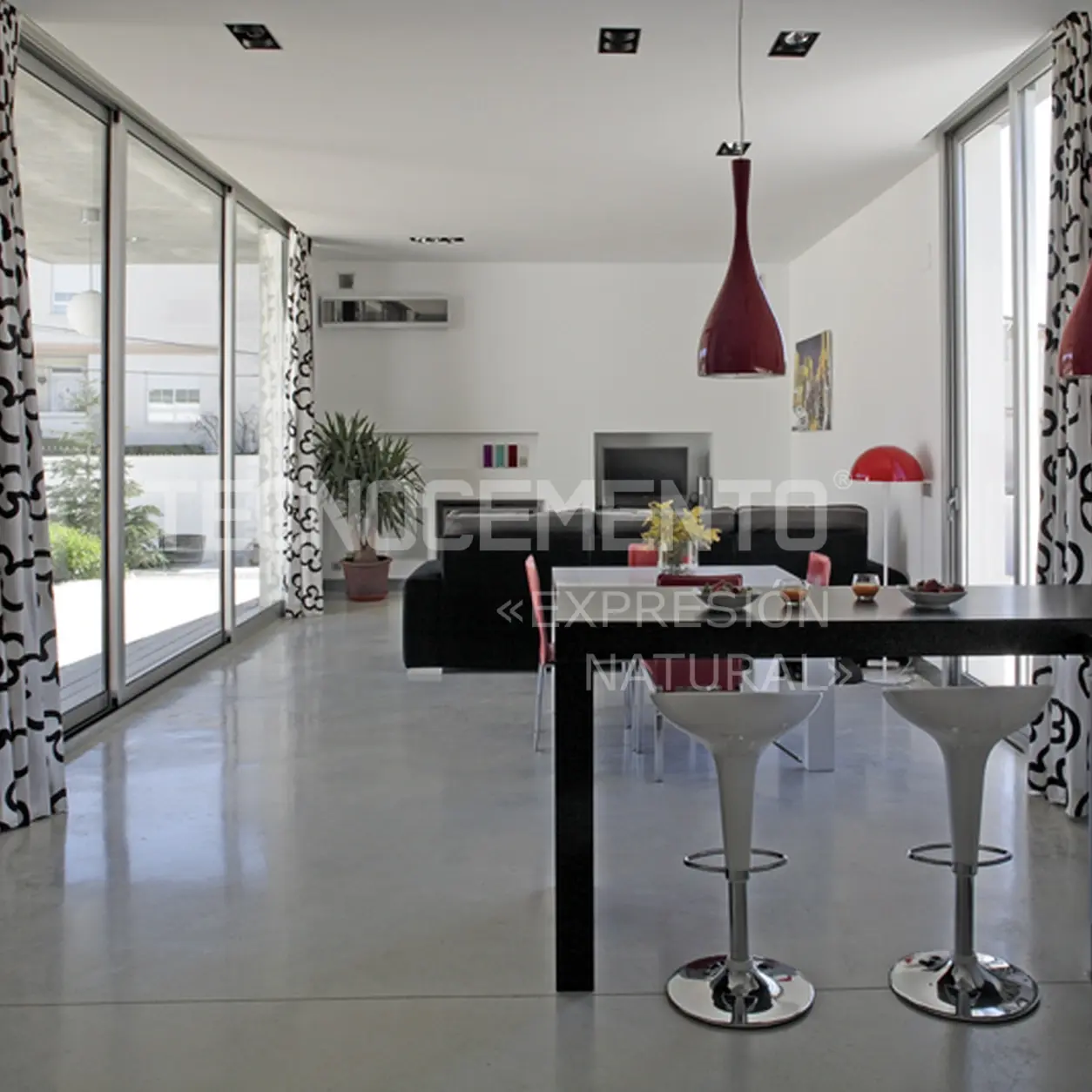
Someone asked me that exact question years ago, and it was what pushed me, as an architect, to develop my own microcement. Around 2005 I started again, in an ordinary commercial unit, applying whatever I could. After a great many failures we hit upon TECNOCEMENTO.
It is almost the same as my concrete: cement, aggregate and water, as in polished concrete floors. What changes is the size: in microcement the aggregate is micronised, mostly silica, finer than beach sand. Where I come from we know what fine sand is worth: in the municipality of Petrer lies the Arenal del Almorxó, a dune that the wind pushed uphill for a very long time until it covered the side of the mountain. Second-rate builders in the fifties nearly finished it off. Today it is a protected natural site.
And it has a few more tricks: additives, which concrete trucks also carry, in smaller proportions, and the resins in component B. It goes on 2 or 3 mm thick and at the end of the job, when nobody is coming through with a wheelbarrow any more. No pumps, no trucks, no protective boards. It is two-component: it contains polymers that give it hardness and others that give it flexibility, because it cannot be a rigid monolith; it moves with its substrate.
It has its own version of the second truckload: if, in the last few buckets, someone overdoes component B or the water, the colour changes. But that risk lies in the applicator’s hands, not in a lorry arriving from a plant. That is why we train every applicator, and when they get their first job approved we give them a stamp with their initials so they can sign their work, like the mason’s marks of the old stonemasons.
Here is a trick. On large areas in houses or commercial premises we do cut joints, but never in the middle of a room: only at door thresholds, with a joint as fine as a hair that you can’t see. You will say it is for expansion. Yes, but hardly. We do it mainly because, after a household accident, we can repair one room without redoing 250 m² of house.
Microcement doesn’t imitate the concrete of polished concrete floors. It is micronised concrete: the same aggregate at another scale, with another thickness and the same beauty.
It is the seamless cement floor I used to make, moved to the end of the job.
Microcement effect tilesAnd now porcelain tile wants to be microcement.
Do microcement tiles exist?
Painted and fired, like a vase.
I open any porcelain tile manufacturer’s catalogue and find wood effect, marble effect, stone effect, encaustic effect and concrete effect tiles. Now microcement effect too. I read on the blog of a Spanish tile shop that concrete effect porcelain “will give you 95% of the look with 100% of the peace of mind” (translated from Spanish), and I am stunned. The missing 5% is exactly what you pay for when you choose microcement.
That isn’t a figure of speech. The pattern on those tiles is a digital image, often scanned from a real material, printed with ceramic inks onto the tile before it goes into the kiln (Qualicer, 2024). Painted and fired, like a vase. The sellers themselves call it “high-definition digital printing”. Vinyl and laminate floors do the same with a printed decorative film. At Granorte, in Portugal, they showed me how cork is printed to look like wood. It is the height of disguise: one noble material dressed up as another noble material.
It doesn’t bother me that porcelain tile is a manufactured material. Microcement is too. What bothers me is that it is sold for what it imitates rather than for what it is. Wood that isn’t wood, marble that isn’t marble, concrete that isn’t concrete. It was born wanting to be something else, and it grew up that way.
Microcement look tiles exist because microcement exists. Nobody makes porcelain effect microcement.
Microcement vs imitation tilesWhat the catalogue doesn’t tell you.
Is microcement better than tiles?
Microcement tiles: joints, price, installation, large format, repair and footprint.
The joints. “Zero maintenance” only applies to the face of the tile. Between one tile and the next there is a porous grout that gets dirty and, in showers, grows mould (Topps Tiles in Ideal Home). Anyone who has lived with tiles for ten years knows the toothbrush.
The price. The price of a microcement tile in the shop is the price of the material. Add the adhesive, the laying and the grout. If the old floor is taken up, add the demolition and the rubble; if the tiles go on top, add the build-up, the doors and the skirting boards. Microcement goes on over what is there. Ask for fixed-price quotes for the whole job and compare those, not the price per square metre in the catalogue. We talk about price openly in our article Microcement: problems, price and trust.
The installation. Microcement goes on over what is there, if the substrate allows it. Porcelain tiles can mean taking up the old floor or laying over it: more than a centimetre of build-up, doors to trim, skirting boards to redo. And it is heavy. A 9.4 mm porcelain tile weighs 20.87 kg per square metre, before the adhesive (AENOR GlobalEPD, 2026).
Large format. The porcelain tile that really looks like microcement is the 120×120 cm with a minimal joint, and it is one of the hardest to lay: a very flat substrate, back-buttering as standard, a deformable (C2 S1) or highly deformable (C2 S2) adhesive and a risk of breakage when handling (ANFAPA). This material that “doesn’t depend on the applicator” depends a great deal on the tiler.
Repair. Replacing a 120×120 cm microcement effect tile laid with back-buttering means breaking it out without damaging its neighbours, and finding another one from the same batch and the same shade, years later. Microcement is repaired with microcement, room by room.
The footprint. According to the same environmental declaration, manufacturing one square metre of this porcelain tile emits 14.4 kg of CO2 equivalent. Add the rubble from the old floor that comes out.
No joints, no piecesFormless, shapeless
Can microcement go on stairs, curves and furniture?
It takes the shape of the space, like water.
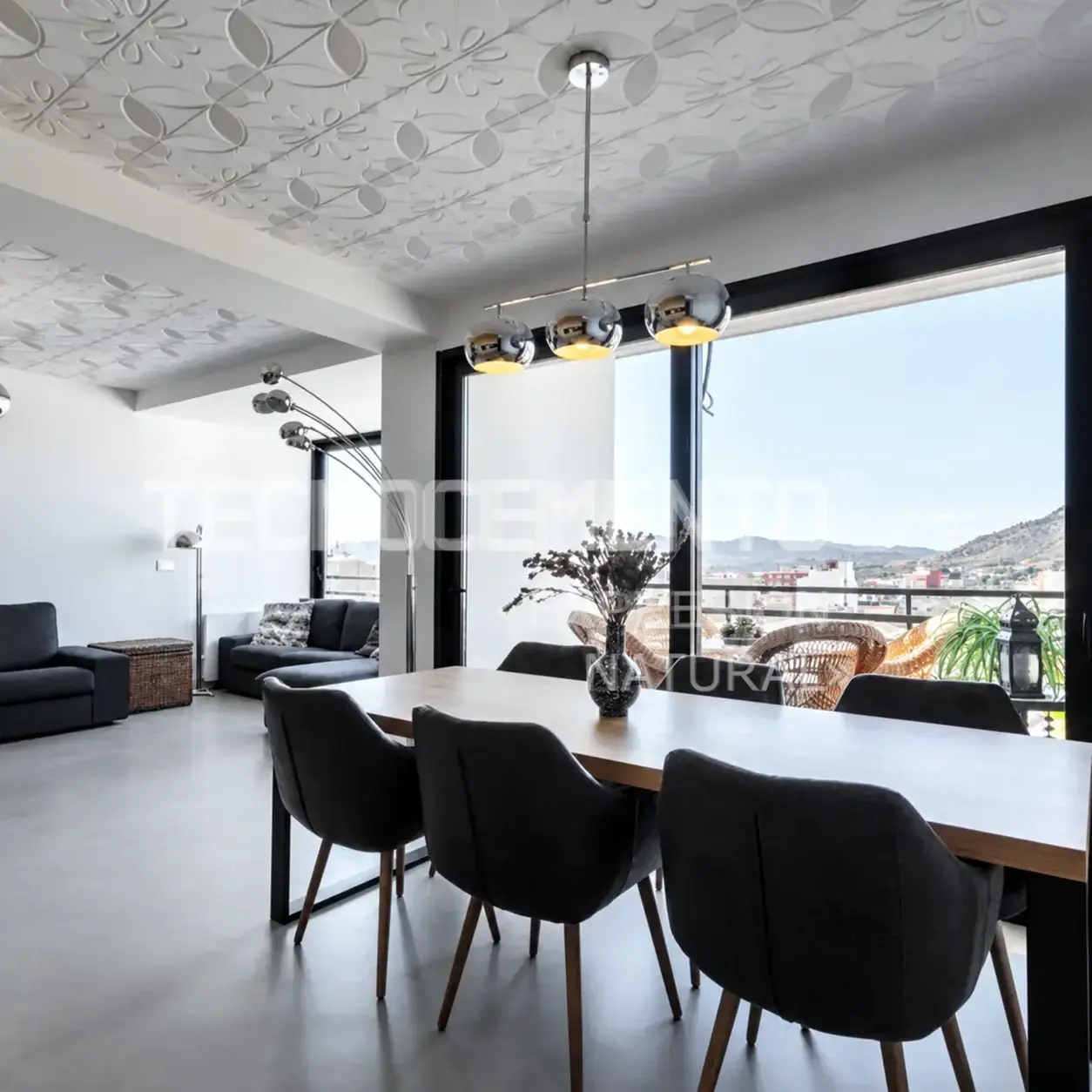
Bruce Lee completed his idea of water: “Empty your mind, be formless, shapeless, like water”. A tile has a shape: it is a rectangle, and anything that isn’t a rectangle means cutting it. A curve, a staircase, a built-in bench, a basin: cuts, mitres and trims. Microcement has no shape of its own. It runs from the floor to the wall and from the wall to the furniture without changing material. It takes the shape of the space, like water.
If it is microcement you have fallen for, choose microcement. A photo of microcement lasts a long time, but it is still a photo.

Frequently asked questionsMicrocement tiles: what people ask us most.
Are microcement tiles real microcement?
No. What is sold as a “microcement tile” is a porcelain tile decorated with ceramic inks that an inkjet printer applies following a digital design that imitates microcement. It is then fired in a kiln. Microcement is a seamless coating applied on site, by hand, without individual pieces.
Can you tell microcement effect tiles from real microcement?
In a catalogue photo, sometimes not. In a home, yes: by the joints, by the pattern repeating across large areas, and because they can’t follow curves, stairs or furniture without cuts.
Do microcement look tiles need maintenance?
The face of the tile, no. The joints, yes: they are filled with grout, which is porous, gets dirty and, in showers, grows mould. Microcement has no joints in the middle of a room; it is protected with a sealer.
Can you put microcement over tiles?
Yes. It is applied over existing floor or wall tiles with the right primer and mesh, without demolition and at 2 to 3 mm thick.
Is microcement cheaper than tiles?
It depends on the whole job. Porcelain tiles often mean taking up the existing floor or building it up, removing rubble and adapting doors and skirting boards. Microcement goes on over the existing floor. The fair comparison is between fixed-price quotes, not the price per square metre of the material.
Does microcement crack?
It can if the substrate moves or if it is applied without the complete system. A two-component microcement with flexible polymers, mesh and a trained applicator greatly reduces that risk.
A real floorTell us what’s underneath.
If you are torn between a tile that imitates microcement and microcement itself, tell us what floor you have now and how you are going to use it. We will tell you which system fits.
Are you a professional? Microcement training by TECNOCEMENTO®
Tomás Amat
Architect · TECNOCEMENTO