
Microcement in bathrooms can develop cracks, delamination, leaks, stains or wear when the substrate, the chosen system, the design or the workmanship does not suit the conditions of use. Preventing these problems means checking the base, resolving junctions and selecting an appropriate solution for each area.
It takes skilled workmanship, or an expert to lend a hand — and that is where we come in.
Visual continuity, a variety of finishes and the possibility of retaining certain existing coverings explain the interest in microcement bathrooms and cloakrooms. But a wall beside a basin and a shower floor are not subjected to the same demands. Nor can a surface that appears sound reveal the condition of the layers underneath.
I am Tomás Amat, architect and CEO of TECNOCEMENTO®. Since 2009, I have spent seventeen years solving real application problems. That experience comes at a cost: we have paid for our mistakes and had to learn from them.
That is one of our strengths: we know about difficulties that a photograph of a finished bathroom does not show. We have learnt to pay attention to what lies underneath, to ask questions before covering it and to recognise when a solution needs more than a good finish.
That is why I want to discuss the disadvantages of microcement clearly. To explain what can go wrong, the reasons behind it and what we should check to reduce the risk. Anyone thinking about renovating a bathroom needs this information before choosing a colour or accepting a quotation.
Seventeen years of experience do not allow us to promise that there will never be problems. They do allow us to approach each job with what we have learnt from solving them.

Where do microcement bathroom problems come from?
There are four key factors in achieving a good microcement finish and enjoying it for years.
The first is the product. At TECNOCEMENTO®, the quality of what we manufacture is our responsibility: selecting raw materials, controlling production and testing performance. This work allows the right system to be chosen for each use.
The second is the applicator. Their skill, care and attention to detail are decisive. A properly executed job carries a responsibility: preparing the surface, respecting waiting times, resolving junctions and taking care over the finish. The result also depends on the sensitivity and judgement of the person working with the material.
The third deserves, in our experience, the most attention: the supporting base. I mean the substrate and the layers that will receive our application. Their condition affects everything we build on top.
A deteriorated, unstable or inadequately prepared base can compromise the whole system. We therefore need to know what is underneath, check its condition and put it right before starting. This part of the work will be hidden, but it demands as much care as the surface we will eventually see.
The fourth is use. A thin continuous coating is not stone: abrasives, impacts, hair dyes or cosmetics left to dry on the surface, and products not approved for the sealer leave their mark. Choosing microcement for a bathroom means accepting responsible use in exchange for continuity and design.
Those troublesome cracks — and delamination: why they happen
The essential requirement is to apply it to a strong, stable and dry surface. A base with existing cracks does not necessarily have to be rejected: we must assess their cause and repair them properly before coating it. When our material is applied, the supporting layers must be firmly bonded and free of unresolved defects such as cracks, flaking, delamination or significant unevenness.
The most frequent causes of cracking are shrinkage in recently applied mortar or screed that has not finished drying, untreated substrate joints — between plasterboard sheets, between a partition and a floor slab, or between tiling and screed — and differential movement between different materials in the same plane. Covering an active crack is scheduling its return.
Delamination follows a different logic. It occurs when the bond between layers fails: a dusty substrate or traces of plaster, paint or grease; a primer or bonding agent unsuitable for the material; moisture trapped in the base exerting pressure from within; or old tiling with tiles that were already hollow underneath. Check beforehand, not afterwards: tap to identify hollow areas, measure substrate moisture and carry out an adhesion test on a small area. These three checks take half an hour and help avoid having to redo the work.
To address these issues, we have repair, smoothing and levelling mortars, as well as consolidants. Their selection and combination depend on the condition of the substrate. At TECNOCEMENTO®, we have developed our own criteria for this preparation.
Do not worry if the substrate is not in good condition: repair it effectively!
Preparing supporting bases properly is an essential part of the application. And, if you need help, we will guide you through the checks and preparation your substrate requires.
Can microcement be applied over tiles without removing them?
Keeping the tiles is an option that must be decided after checking their condition and the compatibility of the system. The phrase “direct application” is incomplete if it suggests that simply coating the surface as it stands is enough.

You need to assess the adhesion of the tiles, damaged areas, joints, residues that could interfere with bonding and the evenness of the surface. Preparation must respond to those conditions. That is why we do not treat it as an identical operation in every bathroom.
Junctions also need to be considered. The thickness of the complete solution, including the necessary preparation, affects its relationship with doors, sanitary fittings, shower screens and adjacent floors. A figure referring only to the final coating does not describe the whole intervention.
Avoiding tile removal can reduce some demolition work. That advantage makes sense when keeping the tiles is technically appropriate. If problems require access to services or replacement of part of the base, retaining every tile should not become a non-negotiable condition.
A clearly defined renovation proposal should explain what will be retained, what will be repaired and what falls outside the initial quotation. The owner then knows what they are commissioning and how defects discovered during preparation will be addressed. Working over an existing finish becomes a justified decision.
What does a shower need to prevent leaks?
A shower requires water protection, drainage and junctions to be resolved together. The choice of coating must form part of that complete solution.
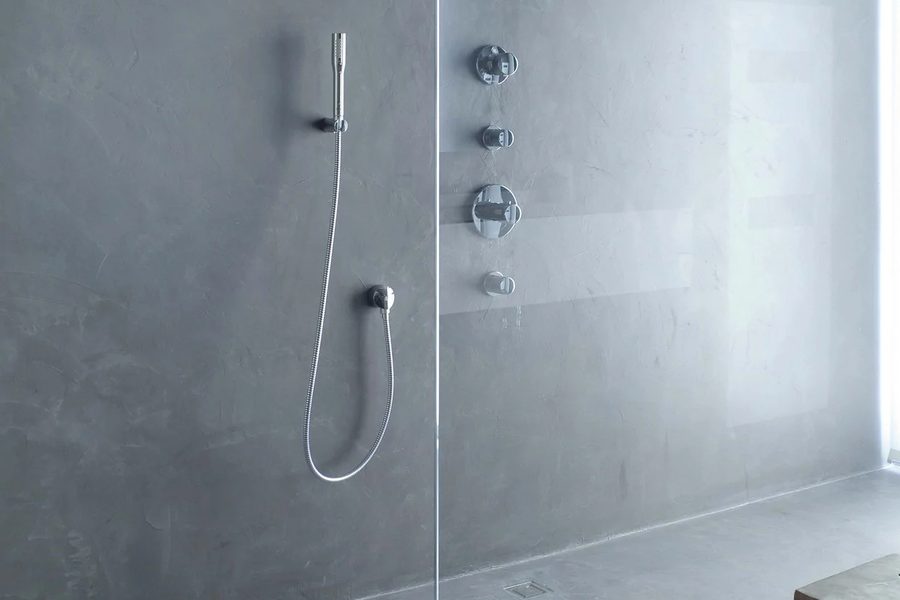
The first question we suggest answering is the function of each component: substrate preparation, the proposed waterproofing, the finish and surface protection. The exact build-up depends on the system. It is not accurate to say that all microcements are waterproof in themselves, nor to rule out a specific solution incorporating that function.
An important point: our products and, in general, good microcements perform very well against positive-side moisture, coming from above towards the surface, such as shower water on the coating.
In our range, TECNOCEMENTO IMPER® is presented as a system for coating and waterproofing bathroom floors and walls, with applications on shower trays, adjacent walls and basins. It is a cement and resin coating two to three millimetres thick, protected with FORTE PLUS sealer. This specification must be developed through the documentation relevant to the work, including junctions and conditions for bringing it into use.
However, negative-side moisture, rising from below because of ground moisture and an inadequately waterproofed substrate, is devastating. There is no remedy unless the surface first receives a specific barrier treatment on the substrate: ordinary bituminous paint or a general-purpose waterproofing mortar will not do.
Drainage deserves attention from the design stage. Its position, the type of drain and the floor geometry must allow proper discharge. The fall must be specified for that configuration; it cannot be deduced from a photograph or resolved through a generic recommendation for every shower. A tray without sufficient fall retains water, and retained water is the main cause of staining and sealer degradation.
Our criterion is a fall of between 2% and 4% towards the drain. Below 2%, water stagnates; above 4%, the slope is noticeable underfoot. This is decided before forming the tray, not after coating it.
The same attention is needed for floor-to-wall junctions, corners and tap penetrations. These are places where materials, planes and services meet. The proposed solution and its compatibility with the system must be understood, including where a shower screen or its fixings will be installed later.
A useful tip: the masonry or plasterboard wall should rest over the shower tray, never butt against it or sit behind it. This solves much more than we might expect.
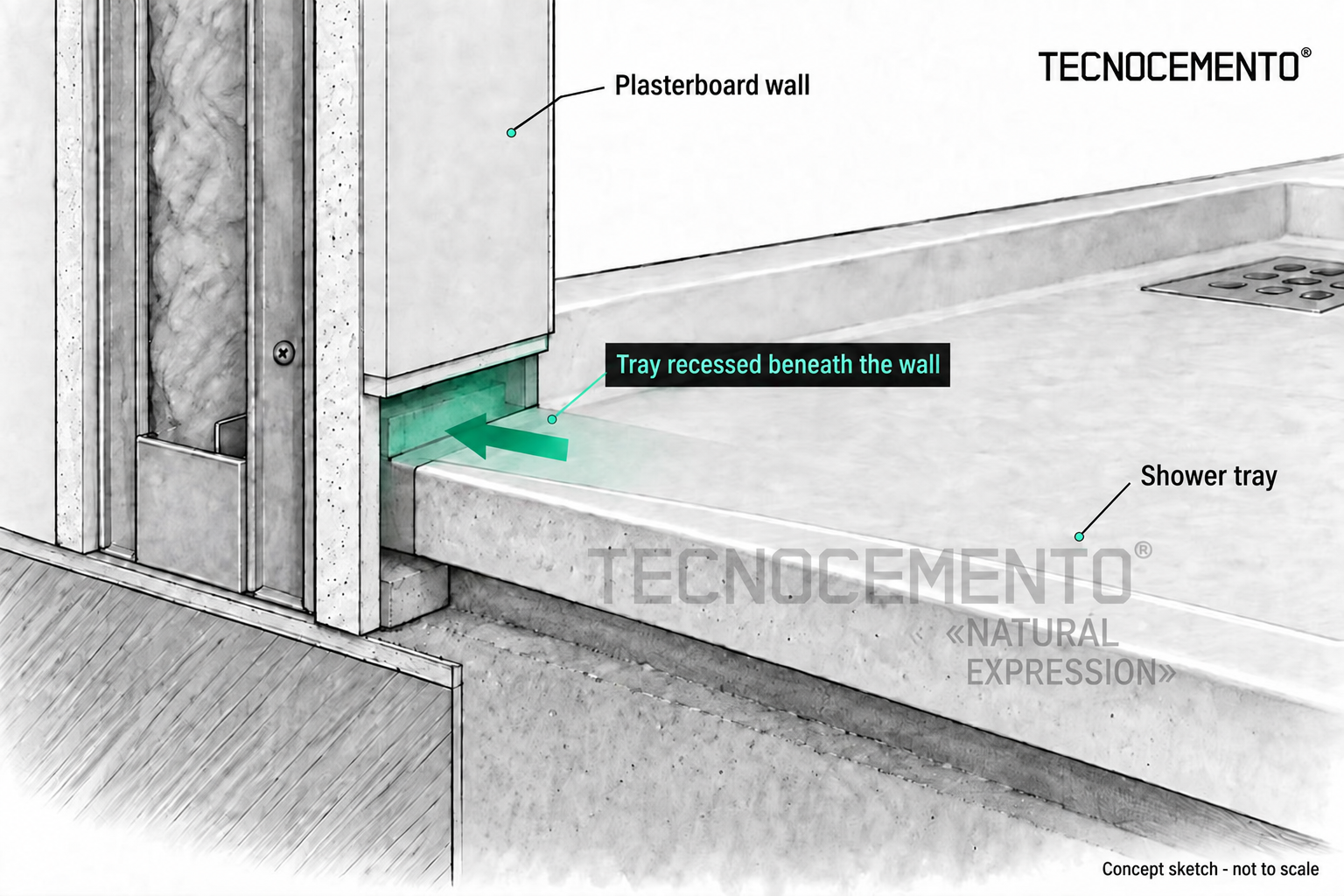
My recommendation for the shower tray
I would not make the shower tray in microcement.
And I say that despite having a suitable product. IMPER is specified for shower trays. But the tray is where everything comes together: water can stagnate, the fall is critical, the drain is a discontinuity and the sealer is subjected to daily use. It is the bathroom area with the least margin for error.
If you still want a microcement tray, doing so means accepting responsible use: no abrasives, no severe impacts, no pooled hair dye and, most importantly, annual maintenance that takes an hour and promises complete happiness.
That annual hour is a condition worth knowing before you choose. If you do not intend to carry out this maintenance, I recommend making the tray from another material and using microcement in the rest of the bathroom.
Our polyurethane varnish sealers, water-based or solvent-based and applied with a roller, improve the product’s resistance. In particular, we have one unlike anything you have seen: we call it “the marvel”.
Does it slip, stain or wear? Finish and maintenance
Slip resistance? Very simple: glass microspheres in the optimum proportions in the top coats. Our finish with microspheres achieves Class 3 under the classification stated in its test report. Ask the applicator for that document and check the test method, conditions and finishing system it refers to: a class number alone is not enough to select a surface. The requirements applicable to the use and location of the project must also be checked.
Stains? Addressed with our Plus Antimanchas finish, “the marvel”. It is the latest development of our polyurethane varnish, with the highest properties of hardness, waterproofing and resistance: single-component, solvent-free (100% solids), odourless and free of volatile organic compounds, with high chemical resistance to domestic products and abrasives — red wine, oil, ketchup, red berries, mustard, coffee, alcohol, bleach and hydrochloric acid — increased surface resistance and minimal change to the appearance of Tecnocemento, with a matt finish. On IMPER, cleaning permits bleach, ammonia and alcohol, without waxes; that compatibility belongs to the installed system and must not be applied to a different one.
Does it wear out? We will wear out first, and that is still a long way off. Wear means relating the choice to traffic and use: a guest cloakroom and a family’s main bathroom are not the same situation.
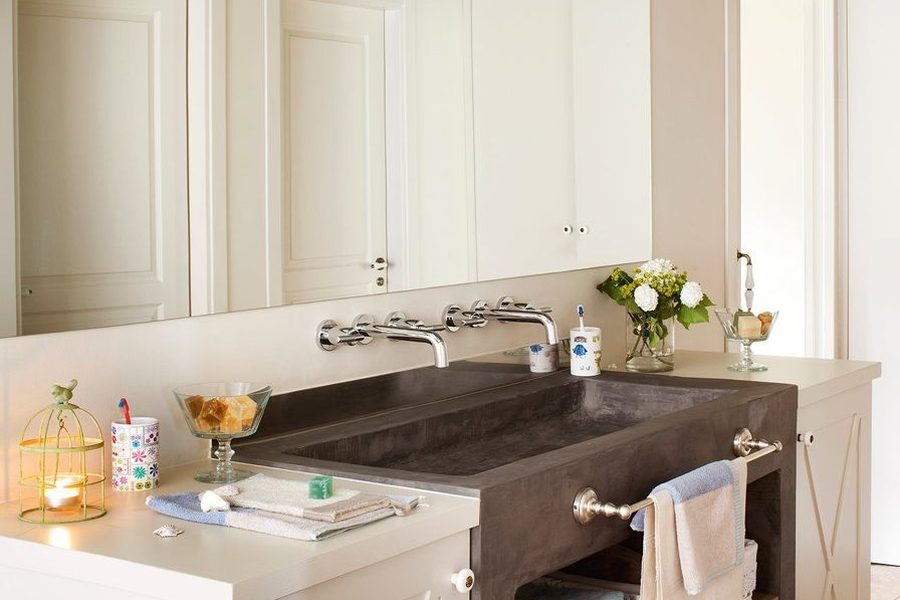
For basins and countertops, it is worth specifying which surfaces will be coated and what contact they will have with water or other products. A vertical face, a countertop and the inside of a basin should not be treated as a single situation simply because they share a colour: the interior receives standing water, soap and limescale every day and places the greatest demands on the sealer.
There is an aesthetic decision too. Microcement can show variations and marks that are characteristic of its finish. We therefore recommend examining a representative sample before work starts and agreeing which variations are acceptable. Mistaking an expected characteristic for a defect afterwards creates a disagreement that could have been avoided.
Colour and sheen should be chosen alongside texture, lighting and cleaning requirements. The bathroom’s appearance then reflects a considered selection, with shared expectations between owner and applicator.

Maintenance: an hour’s work does not mean immediate use
An hour’s work does not mean that the shower can be used immediately. After renewing the protection, the waiting time specified for the sealer and the application conditions must be respected. The applicator should state separately how long the work will take and when the surface can come into contact with water again.
Maintenance and bringing the surface into use must follow the instructions for the installed system, not only in the shower but also on walls, floors, countertops and basins. We may not be used to it, but just as we change the filters and oil in our cars to make them last longer, floors and other elements in our homes also need maintenance. There is no single waiting period or universal sealer renewal interval for every microcement; in areas directly exposed to water, our criterion is an annual inspection.
At handover, a distinction should be made between drying between coats, curing and the conditions for using the room again. A surface that looks dry does not allow you to establish by observation when it can receive water, cleaning or its intended use.
The programme should take these periods into account from the quotation stage. If this is a home’s only bathroom, knowing when the basin and shower can be used has practical consequences. The timings must come from the relevant documentation and account for the actual application conditions.
Cleaning also requires specific instructions. The owner needs to know which products can be used, how to use them and which are incompatible. It is worth consulting our maintenance products when choosing the finish; a general recommendation that ignores the chosen finish is not enough.
For the sealer, it is useful to know which signs call for an inspection and who should assess whether work is needed. Saying it must be reapplied “every few years” without identifying the product, use and condition creates an unfounded maintenance expectation.
We believe handover should include the names of the system and finish, their care instructions and a contact for reporting problems. With this information, looking after the surface no longer depends on advice found for products that may be different.
What should you check before choosing the system and bringing it into use?
The choice is reasonable when the substrate can be properly prepared, a system is specified for the intended use, and the application and maintenance are clearly defined.
Someone who chooses microcement for its appearance and accepts that small imperfections are part of the system is choosing a coating designed to last, with the maintenance appropriate to the system applied.
Before starting, five questions should be answerable. Which base will be retained and how will it be prepared? How will areas exposed to water be addressed, including moisture that may rise through the substrate? What performance will each finish provide? When can the bathroom be used? And what care will it need, with permitted and prohibited products stated in writing?
The answers should form part of the proposal, rather than being left unresolved until the end.
It is also worth agreeing how any problem will be handled: who will inspect it, what documentation will be kept and what an eventual repair would cover. This is not about assuming that problems will arise, but about defining responsibility for the work.
Once these conditions have been resolved, visual continuity and design possibilities can be assessed with sound judgement. Choosing microcement colours will then be a decision integrated with the rest of the bathroom.
For me, a well-planned renovation starts with being able to explain these decisions. That is the value of experience: turning the problems we have solved into more demanding criteria for the next job.
Tomás Amat, architect and CEO · TECNOCEMENTO®