
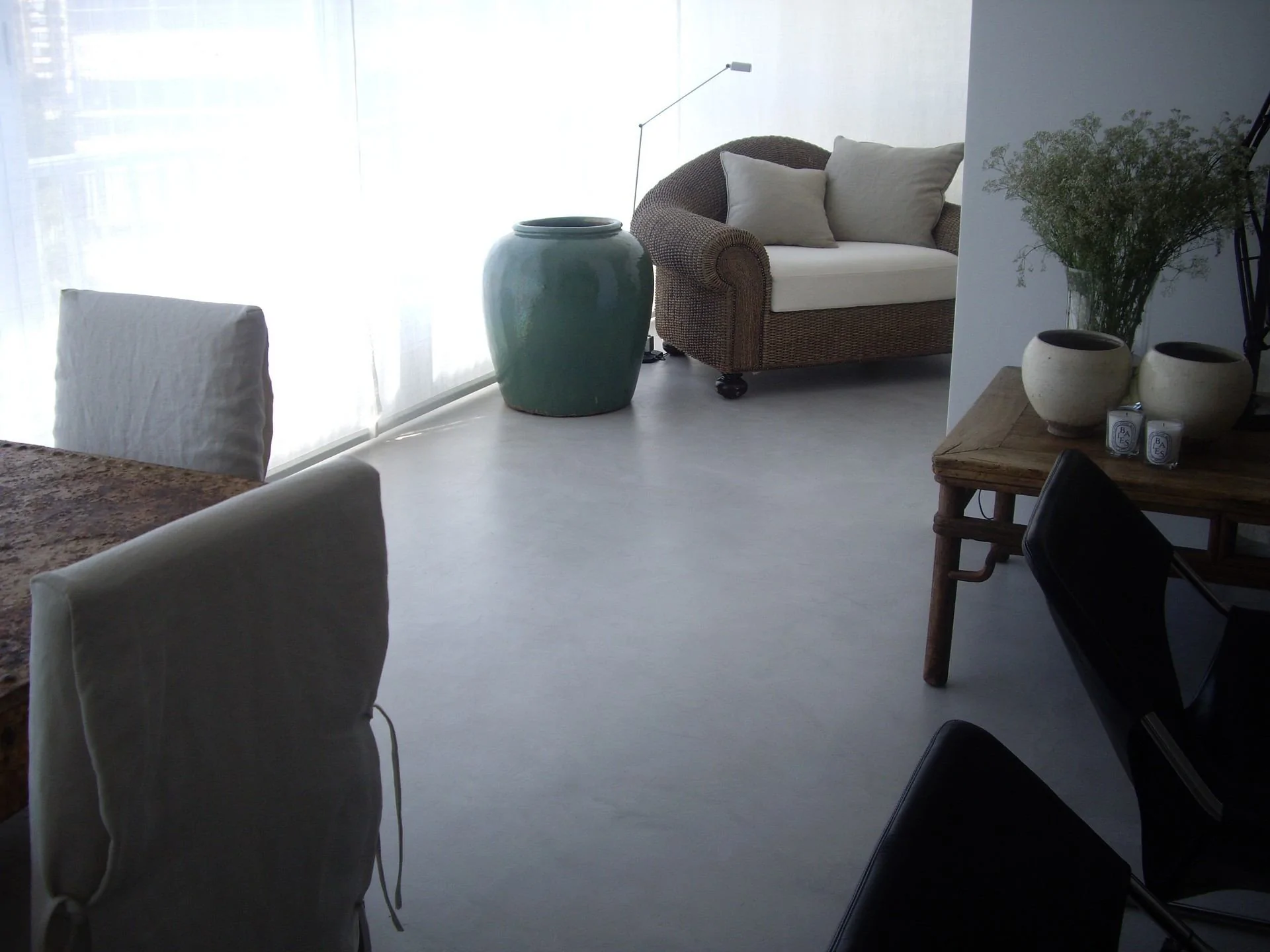
A single continuous plane runs through the interior and draws the eye outside. The floor stops being a sum of pieces and begins to organise distances.
Microcement flooring creates a single plane that can flow through rooms, connect uses and reduce visual interruptions. At TECNOCEMENTO®, that is precisely what interests us: not a collection of coated square metres, but a surface that can take over the entire floor plan without fragmenting it.
Microcement floors have something of humble luxury and imperfect perfection. They seem quiet, yet have an enormous presence. They need neither pattern, joints nor repetition to make themselves felt. Precisely because the individual piece disappears, the surface emerges.
One element running through the floor plan
Conventional flooring tends to constantly explain how it is built. Each joint measures the room again. Each piece establishes a scale. Each change in format introduces another interruption.
Microcement flooring works differently.
By reducing these visual divisions, a single surface can extend through the kitchen, living room, corridor or bedroom, establishing a relationship between them that did not previously exist.
This does not mean the rooms disappear. It means they no longer need different flooring to show that they are different.
The kitchen remains a kitchen. The living room remains a living room. But both can belong to the same material territory.
The floor unifies. Architecture differentiates.
The silent conquest of space
Microcement starts at one point and seems to want to keep going.
It crosses a doorway.
It turns a corner.
It reaches a staircase.
It approaches a wall.
And suddenly we discover that the boundary between one room and another was no longer necessarily in the floor.
Visually, it behaves like a fluid. Not because it is poured — that is not how it is applied — but because its continuity seems to follow a similar logic: advancing, enveloping, finding the next plane, occupying the interval until separate surfaces become a single field.
It is a fluid at rest: solid matter that retains, in our perception, the memory of movement.
The floor seems to have flowed before hardening. It moves from one room to another without asking permission, goes around a piece of furniture, reaches a step and continues. Where a tile ends, microcement seems to wonder what comes next.
It does not occupy rooms. It builds territory.
Continuity does not mean an absence of limits
The image of a fluid is useful, but it too has a limit. Microcement’s visual continuity does not justify ignoring the building’s movements or joints that must be respected for technical reasons.
A substrate may require structural joints, expansion joints or specific solutions at certain junctions. Covering them indiscriminately does not make the floor more continuous. It may simply make it more vulnerable.
At TECNOCEMENTO®, we therefore distinguish between visual continuity and construction continuity.
The former can extend extraordinarily far.
The latter must always respond to what happens beneath.
The floor eventually reveals what the substrate tries to hide.

A continuous material that is never identical
A microcement floor can extend for tens of metres without being exactly the same at every centimetre.
And that accounts for much of its character.
Manual application can leave subtle mottling, movement, variations in shade or slight differences in texture. We are not talking about defects, but the characteristic traces of a worked material.
That is why we defend an idea that may seem contradictory:
Imperfection is part of the system.
But only up to a point.
A slight variation in shade is one thing. A stain is another. Seeing the movement of the trowel is one thing. Poor workmanship is another. A living surface is one thing. An active crack is another.
Imperfection belongs to the material.
Shoddy workmanship does not.

Continuity also needs strength
The floor is probably where microcement has to prove the most things at once.
Looking attractive is not enough.
There are footsteps. Moving chairs. Furniture. Cleaning. Sand. Impacts. Water. Everyday use.
So when we talk about microcement flooring, we are not just talking about a continuous aesthetic. We mean a system in which the substrate, preparation, microcement layers, surface protection and intended use must be compatible.
The final appearance may seem extremely simple.
The solution that maintains that simplicity is not.
Which system to choose for a microcement floor
Colour does not determine the system: intended use, mechanical demands, contact with water and the condition of the substrate do. These are the three TECNOCEMENTO® systems we most frequently use for flooring, and the projects where you can see them applied.
Medium pedestrian traffic
Tecnocemento Plus®
Cement and acrylic resins in a 2–3 mm layer, over previously corrected terrazzo, tiles or self-levelling screeds. This is the system for homes and premises with moderate use, offering the most varied and deep texture. It is not recommended for areas in contact with water.
Heavy pedestrian traffic
Tecnocemento High Transit®
Formulated with an epoxy component for floors with very high mechanical demands: restaurants, shops, offices and public spaces, including outdoors. The Forte Plus sealer allows cleaning with more aggressive products, and no wax is required.
Heavy traffic and industrial aesthetics
Tecnocemento Industry®
Two components, 2–3 mm thick and a larger aggregate size that gives the floor a rustic, uniform appearance. For commercial interiors and outdoor microcement applications such as façades and terraces, and suitable for areas in contact with water.
Floors with permanent water exposure or immersion: Imper. All systems are applied without demolishing the existing flooring, adapting it to achieve the necessary flatness. If you are looking for the price of microcement flooring per m², it depends on the system, substrate and area: we explain it plainly in Let’s talk frankly.

The floor begins before the microcement appears
The most important decision about a microcement floor probably remains completely hidden once the work is finished.
It is the substrate.
Its stability, flatness, adhesion, moisture, cracks and junctions determine how the coating will subsequently perform.
That is why at TECNOCEMENTO® we prefer to start by discussing what nobody will ultimately see. It may be less appealing than choosing a colour. But it is considerably more important.
A good finish applied to an unsuitable substrate is still a well-finished problem.
Colour never comes alone
On an extensive surface, colour takes on a different intensity.
A small sample allows you to choose a shade.
A whole floor allows you to understand it.
Natural light, orientation, shadows, wood, stone, furniture and the size of the room continually change how it is perceived.
That is why grey is never simply grey. It can become cooler in north light, warmer beside wood, disappear under diffuse lighting or acquire an enormous presence in grazing light.
On a continuous floor, colour does not occupy a piece: it occupies the space.
When the floor disappears
A floor can constantly draw attention to itself.
Or it can do something much harder.
It can step back.
Not disappear physically, but stop competing with what happens above it.
At TECNOCEMENTO®, this moment particularly interests us: when the material has run through the floor plan, connected the rooms and absorbed many of the visual interruptions; when furniture, light, people and architecture begin to take centre stage.
Then comes the final paradox:
The floor conquers the space precisely when it stops claiming it for itself.
And perhaps that is the best definition of a good microcement floor: a single surface capable of flowing through architecture until we stop looking at the flooring and start perceiving the space.
Tomás Amat
Architect · TECNOCEMENTO®
From material to project
If this way of understanding flooring fits your project, these are some useful next steps.